EMPOWERING EDUCATORS AT
COPENHAGEN BUSINESS SCHOOL
COPENHAGEN BUSINESS SCHOOL

Each course within a CBS programme contributes directly to developing the knowledge, skills, and competencies outlined in the programme’s overall profile. When designing a new course, one of the most important steps is to clearly articulate the specific learning objectives students are expected to achieve.
It is recommended that a course includes 4–7 clearly formulated and measurable learning objectives. These objectives must be aligned with the teaching activities and the assessment format in the course. This essential coherence between learning objectives, teaching, and assessment is usually referred to as constructive alignment and is illustrated in the model below.
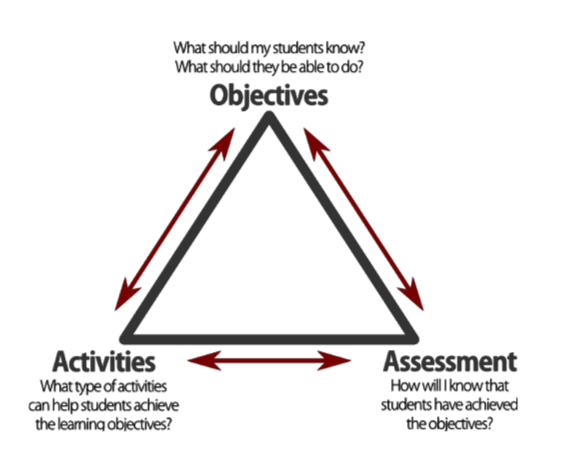
In practice, this means that students should have the opportunity to engage in learning activities that support the development of each objective, and that the objectives are assessed using forms that appropriately reflect what students are expected to demonstrate.
TIPS ON WRITING LEARNING OBJECTIVES:
A measurable learning objective clearly states what students should be able to demonstrate or produce as evidence of their learning. Measurability ensures that the objective can be assessed in a concrete and observable way — either through written work, oral performance, practical tasks, or other forms of evaluation.
This means using action-oriented verbs (e.g. describe, analyze, compare, apply, evaluate) that indicate specific student behaviours or outputs. Vague terms like understand, know, or be familiar with should be avoided unless they are clarified through observable criteria.
For example:
In short, measurability is about making it clear how you (as the teacher) can tell whether students have achieved the intended outcome.
Learning taxonomy
CBS recommends developing learning objectives using either SOLO Taxonomy (Structure of Observed Learning Outcomes) or Bloom’s Taxonomy, which both offer structured ways to describe different cognitive levels of learning.
Both Bloom’s Taxonomy and the SOLO Taxonomy are frameworks for describing and designing learning objectives, but they differ in focus and structure.
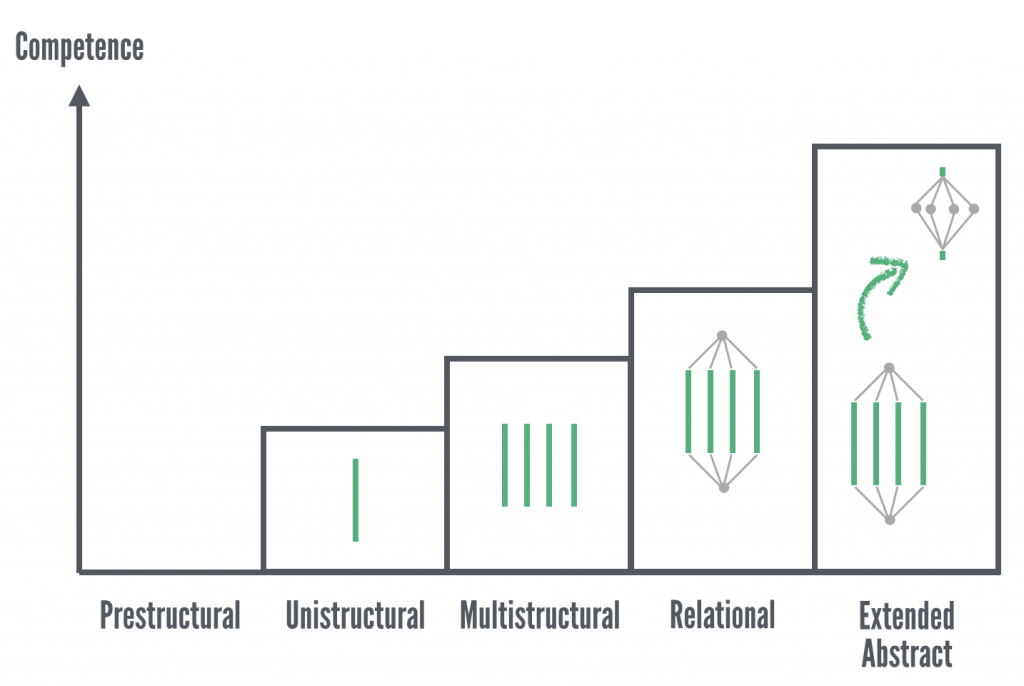
SOLO Taxonomy focuses on the quality and complexity of student understanding. It describes how learning progresses from surface to deep understanding, across levels: prestructural, unistructural, multistructural, relational, and extended abstract. In short: SOLO is about the depth of understanding (e.g. fragmented vs. integrated knowledge). | Bloom’s Taxonomy categorizes learning according to types of cognitive processes, such as remembering, understanding, applying, analyzing, evaluating, and creating. It helps instructors specify what kind of thinking students should engage in. In short: Bloom is about the type of thinking (e.g. apply, evaluate). |
The SOLO Taxonomy was developed by Australian educational psychologist John Biggs in the 1980s and is still widely used today.
The rationality behind this structure is based on the fact that knowledge builds on increasingly higher levels of complexity, where the lower levels constitute and are prerequisites to the higher levels of complexity. The prestructural, the unistructural, and the multistructural levels refer to the surface levels of learning. Within the relational and extended abstract levels, students acquire a level of deep learning, where they are able to connect the concepts taught to other problems or disciplines and can create meaningful distinctions between these.
REFERENCES:
Biggs, John B.; Collis, Kevin F. (1982). Evaluating the quality of learning: the SOLO taxonomy (structure of the observed learning outcome). Educational psychology series. New York: Academic Press.
Biggs, John B.; Tang, Catherine Sokum (2011) [1999]. Teaching for quality learning at university: what the student does (4th ed.). Maidenhead: McGraw-Hill; Society for Research into Higher Education; Open University Press.
RESOURCES:
In 1956, Benjamin Bloom, an educational psychologist – together with a committee of educators in the USA – developed a hierarchical model of learning objectives, classified by their level of complexity. This model is what we today know as Bloom’s taxonomy, where a number of educational domains were sorted into their cognitive hierarchical order, going from knowledge, comprehension, application, analysis, synthesis to evaluation. In 2001, the taxonomy model was revised by a group of educational psychologists and instructional researchers, who not only changed the terminology from nouns to verbs, e.g., from ‘evaluate’ to ‘evaluating’, and ‘application’ to ‘applying’, but also changed the foundational structure of the taxonomy, developing a three-dimensional perspective on learning attainment. The revised Bloom’s taxonomy is what many educational researchers and instructional designers rely on today when designing and developing meaningful, constructive, and specific learning outcomes.
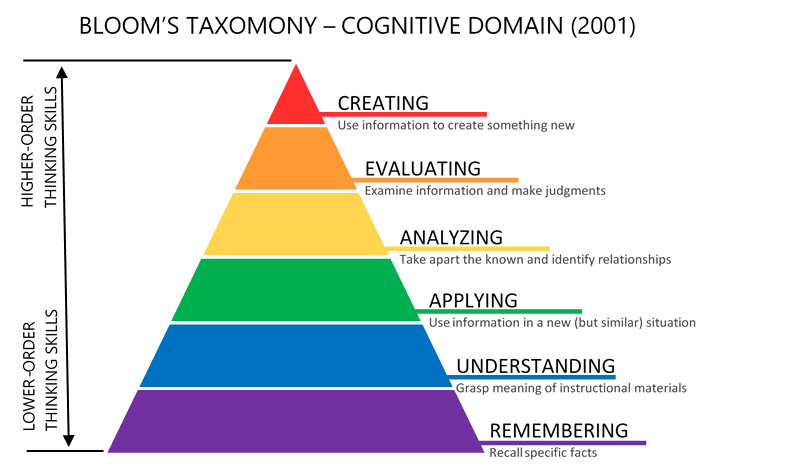
When writing learning outcomes based on Bloom’s taxonomy, it is important to consider the prerequisites of the students – what types of knowledge, skills, and competencies are they expected to possess at this point in the learning journey? This can help identify on what cognitive level the learning outcomes of your course and course activities should derive from. Other aspects you can consider are
REFERENCES
Anderson, Lorin W.; Krathwohl, David R., eds. (2001). A taxonomy for learning, teaching, and assessing: A revision of Bloom’s taxonomy of educational objectives. New York: Longman.
Bloom, B. S.; Engelhart, M. D.; Furst, E. J.; Hill, W. H.; Krathwohl, D. R. (1956). Taxonomy of educational objectives: The classification of educational goals. Handbook I: Cognitive domain. New York: David McKay Company.
Forehand, M. (2005). Bloom’s taxonomy: Original and revised. In: M. Orey (Ed.), Emerging perspectives on learning, teaching, and technology.
RESOURCES: